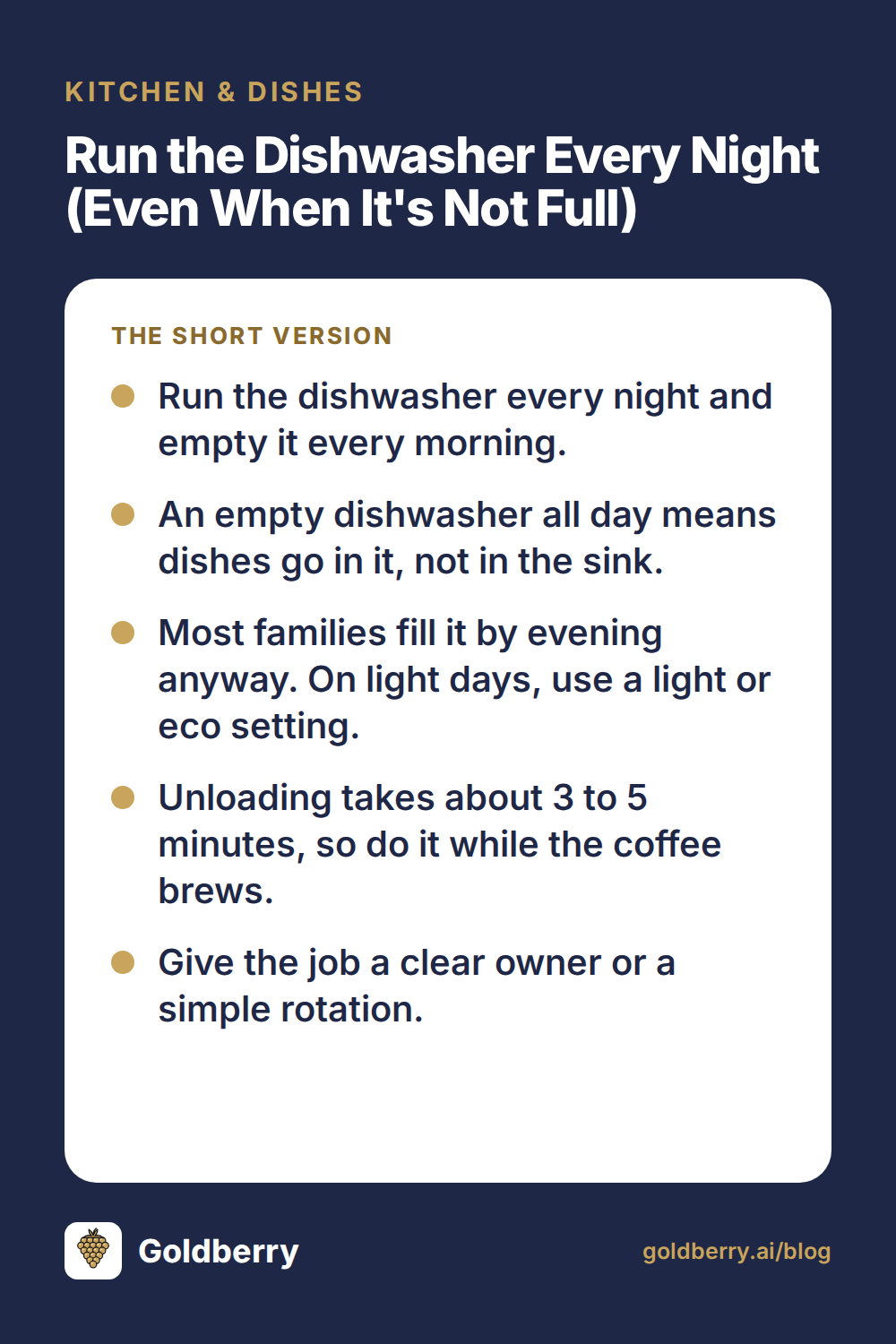
Run the Dishwasher Every Night (Even When It's Not Full)
Run the dishwasher every night and empty it every morning, and the sink stays clear. How the routine works, who owns it, and what to do on light days.
Yes, you should run the dishwasher every night, even when it isn't completely full. When it runs after dinner and gets emptied in the morning, there is always an empty dishwasher waiting, so dirty dishes go straight in instead of piling up in the sink.
It's one of the simplest kitchen habits there is, and it saves the time you'd spend digging out a full sink. On most nights there's no need to ask whether it's full enough: dinner is done, so it runs.
The rule: run it every night, empty it every morning
The whole system is two habits tied to two times of day.
- After dinner, as the last step of cleaning up the kitchen, add detergent and start the dishwasher while everyone is still up.
- In the morning, before breakfast dishes start coming, empty it.
That's it. From the morning unload until dinner, the dishwasher is where dirty dishes go. Every cup, plate and fork goes straight in as soon as it's used.
Sinks fill up when the dishwasher is already full, either with clean dishes nobody has put away or with dirty ones waiting for a full load. Either way, new dirty dishes have nowhere else to go.
Why a half-full run beats a full sink
Waiting for a perfectly full load sounds efficient, but here's what tends to happen. The machine is two-thirds full at bedtime, so nobody runs it.
In the morning it's still dirty, so breakfast dishes go in the sink. By dinner the sink is full, the dishwasher is full, and someone loses part of the evening sorting it out.
Running it nightly trades a slightly lighter load for a clear sink every day.
| Run when full | Run every night | |
|---|---|---|
| Where dirty dishes go | The sink, whenever the machine is full or clean | Straight into the dishwasher |
| In the morning | Guess whether it's clean or dirty | Clean and ready to unload |
| The sink | Fills up on busy days | Stays mostly empty |
| Smells | Dishes can sit for days | Dishes sit less than a day |
| Decisions | "Is it full enough?" every night | Almost none |
There's a cleaning benefit too. Food that sits on dishes for two or three days dries hard and can start to smell. Dishes that get washed the same night come out cleaner.
Fewer small decisions also make a house run more smoothly. If that idea appeals to you, there's more on cutting decision fatigue at home.
Most nights it will be full anyway
A full load gets the most out of each cycle. Many dishwashers use roughly the same water on a regular cycle whether the racks are packed or half empty, so it pays to load well.
The good news: if you cook at home and have more than a couple of people in the house, the dishwasher usually fills by evening without trying. Breakfast bowls, lunch containers, cups through the day, then dinner plates and pots. The nightly rule rarely means running it mostly empty.
When it isn't full, you have options:
- Light or eco setting. Many machines have a light-load, eco or half-load cycle. Check your manual for what yours offers.
- Load it well. A well-loaded machine fits more and cleans better. Here's how to load a dishwasher so everything comes out clean the first time.
The 5-minute morning unload
Emptying the dishwasher feels like a big chore, but it usually takes about 3 to 5 minutes. That's about how long it takes to brew a pot of coffee or boil a kettle.
So tie it to that. Start the coffee, open the dishwasher, unload. By the time your cup is ready, the job is done.
To make it faster:
- Unload the bottom rack first, so any water pooled on top of cups doesn't drip onto the dry dishes below.
- Empty the utensil basket one compartment at a time, one grab per type, straight into the drawer.
- Stack plates and bowls on the counter by type, then put them away in one trip per cupboard.
If your everyday dishes live in the cupboards closest to the dishwasher, it gets even faster. Move them there if they aren't already.
Who owns the dishwasher
A routine with no owner turns into a routine nobody does. Decide who starts it after dinner and who empties it in the morning.
Some setups that work:
| Setup | How it works | Best for |
|---|---|---|
| One owner | The same person runs and empties it every day | Couples, or one early riser |
| Split shift | One person starts it after dinner, another empties it in the morning | A night owl and an early bird |
| Weekly rotation | Each person owns it for a full week | Teens and adults sharing a home |
| Kids unload | Kids empty it, adults run it | Kids old enough to reach the cupboards |
Even young kids can put away utensils and plastic cups. For what each age can handle, see these chores for kids by age.
Whatever you choose, write it down where everyone can see it. That ends the "I thought you were doing it" conversation.
What to do on light days
Some days the house is quiet. One person home, takeout for dinner, a few mugs in the rack. Here's how to handle it without breaking the habit:
- Half full or more: run it. Use a light or eco cycle if you have one.
- Just a few items: run it anyway if keeping the rule simple matters most to you, or skip one night and run it the next night without fail.
- Going away for a few days: run it the night before you leave, while you're home, even if it's light, so nothing sits dirty while you're gone.
The goal is a dishwasher that never sits full of dirty dishes for days. On most nights that means running it. On a rare quiet night, skipping is fine.
Make it a habit that sticks
Habits stick best when they're attached to something you already do. Starting the dishwasher works best as the final step of your evening kitchen cleanup: clear, load, start, wipe. A short kitchen reset routine gives it a fixed spot every night.
A few small things help:
- Keep detergent right next to the dishwasher, not in another cupboard.
- Buy more detergent when you open the last box, not when it runs out.
- If several people use the kitchen, agree on a simple signal for "clean, unload me," like a magnet on the door.
- Start it right after dinner, so it finishes while people are still up.
After a couple of weeks, a full sink will start to look strange.
FAQ
Is it OK to run the dishwasher every night?
Yes. Dishwashers are built for regular use, and a nightly run keeps dishes from sitting dirty and the sink clear. On light nights, use a light or eco cycle if yours has one, and keep up with the care your manual lists, like cleaning the filter.
Is it better to run the dishwasher at night or in the morning?
Evening usually works better. Start it right after dinner while people are still up, and it's clean by morning, ready to empty before breakfast. Then it sits empty for dirty dishes all day.
Is it wasteful to run the dishwasher when it's not full?
A full load gets the most out of each cycle, so it's worth loading well. Still, a nightly run on a light or eco setting is usually a better trade than dishes piling up in the sink and getting washed by hand. Most households fill the machine by evening anyway, so truly half-empty runs are rare.
How long can dirty dishes sit in the dishwasher?
A day is fine. After two or three days, food dries on hard and the machine can start to smell, which makes for a tougher wash. If you need to wait, some machines have a rinse-only cycle that keeps food from drying on.