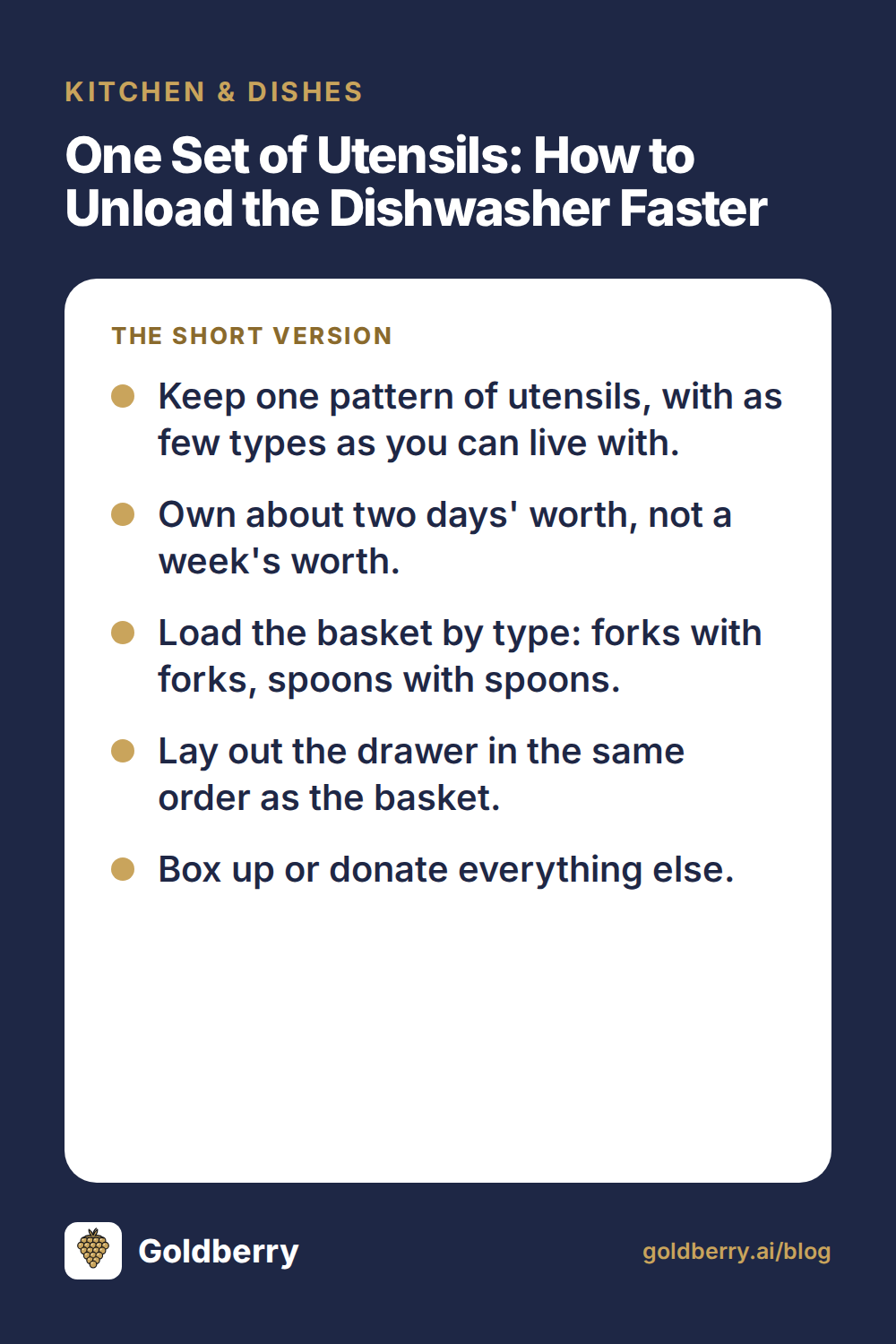
One Set of Utensils: How to Unload the Dishwasher Faster
Mixed forks and spoons turn the dishwasher unload into a sorting job. One matching set of utensils, sorted as you load, empties in under a minute.
The fastest way to unload the dishwasher is to own one matching set of utensils and sort them by type as you load. When every fork is the same fork, emptying the basket takes one grab per compartment, straight into the drawer, in under a minute.
Mixed sets usually happen by accident. A wedding set, a box from a first apartment, a few strays from takeout and the kids' spoons all end up in one basket, and every unload turns into a small sorting job.
Why mixed utensils slow you down
Unloading a basket of mixed utensils is a hundred tiny decisions. Is this the big fork or the small fork? Where does the plastic kid spoon live?
None of these choices takes long on its own. Together they turn a quick job into one people put off, and a dishwasher nobody empties is how dishes end up in the sink.
The drawer suffers too. Two fork sizes means two piles that drift into each other, and soon nobody can find a matching pair at dinner.
What "one set" actually means
One set means one pattern and one size for each type of utensil. For most homes that is four types:
- Dinner forks
- Dinner knives
- Large spoons (for soup, cereal and serving yourself)
- Teaspoons
Every extra type is another compartment to sort and another slot in the drawer. Salad forks and dessert spoons are lovely, but in a busy house they are mostly a sorting step. If you rarely use them, let them go.
Kids are the usual exception. If small hands need small utensils, pick one kid set in a single style or color so it sorts as its own type. Serving spoons, spatulas and ladles are a separate category and can stay as they are.
How many utensils you really need
More utensils feels convenient, but it hides the problem. If you own forty forks, the basket can sit unemptied for days and the drawer never forces the issue.
If you run the dishwasher every night, about two days' worth is plenty. You always have a full drawer while one day's set is in the machine.
| People at home | Forks | Knives | Large spoons | Teaspoons |
|---|---|---|---|---|
| 1 to 2 | 8 | 6 | 8 | 8 |
| 3 to 4 | 16 | 8 | 12 | 12 |
| 5 to 6 | 24 | 12 | 18 | 16 |
Forks get used at most lunches and dinners, so they need the biggest count. Knives get used less, so you can own fewer. Adjust from there: a family that packs lunches every day may want a few more forks, and a household that rarely eats at home needs fewer.
Sort as you load, not as you unload
This is the part that makes the whole system work. Sorting has to happen once, and loading is the moment you already have each utensil in your hand.
- Give each type its own compartment in the basket. Forks in one, spoons in another, knives in a third.
- Drop each utensil in its compartment as you clear the table. It takes no extra time.
- Put most utensils in handles down so the eating ends get the most water.
- Put sharp knives in blade down, for safety, or wash good knives by hand.
Some cooks prefer handles up so their fingers never touch the eating ends when they unload. Both work. Pick one way for the household and stick with it, because consistency is what speeds up the unload.
If you have more forks than one compartment holds, split them across two compartments next to each other. If your dishwasher has a flat cutlery tray on top, give each type its own lane.
For the rest of the machine, the same idea applies: load the dishwasher in a set order so the unload follows the same path every time.
Set up the drawer to match the basket
Now the unload is almost automatic:
- Lift the whole basket out and set it on the counter by the drawer.
- Grab one compartment's handful of forks and drop it in the fork slot.
- Repeat for spoons, teaspoons and knives.
That is four grabs. With one set and a sorted basket, there is nothing to check.
A few details help:
- Keep the drawer close. The utensil drawer should be the one nearest the dishwasher, ideally right next to it.
- Use a simple organizer. One slot per type, in the same left-to-right order as your basket.
- Leave a little room. A drawer packed to the edges slows you down every time. Two days' worth fits easily.
Retire the extras
The hardest part is letting go of the strays. You do not have to throw anything out.
- Party box. Put extra utensils in a labeled box on a high shelf for holidays and big dinners. Bring them out, wash them, put them away.
- Donate the odd ones. Single forks from three different sets help nobody.
- One shared set for the kids. Pick the kid utensils you like best and box the rest.
Try it for a couple of weeks. Outside of holidays, the box rarely comes down.
What a matching set costs
A plain stainless steel set for a family of four costs about the same as a takeout dinner or two, and it lasts for years. A few things make it a better buy:
- Buy open stock. Choose a pattern sold by the piece, so you can replace a lost spoon instead of buying a whole new set.
- Check that it is dishwasher safe. Plain stainless steel is the easy choice. Wooden handles, bone, and some colored or gold finishes do not hold up in a dishwasher.
- Look at the steel grade. Sets marked 18/10 have more nickel and resist spots and rust a little better than 18/0. Either works fine for daily use.
Buying fewer pieces usually pays for the upgrade.
The same idea works all over the house
One set of utensils is a small version of a big rule: when things are identical, putting them away takes no thought.
- One style of drinking glass stacks the same way every time.
- One size of plate and bowl means one stack each in the cabinet.
- Matching food containers with one or two lid sizes end the lid hunt.
- One sock style per person means you never match socks. Here is how to skip sock matching and fold less.
Each one saves a few seconds. Repeated every day, they add up to real time, and they make the jobs easy enough that anyone in the house can do them.
FAQ
How many utensils does a family of four need?
If you run the dishwasher every night, about 16 forks, 12 large spoons, 12 teaspoons and 8 knives is plenty. That covers two days of lunches and dinners, so the drawer never runs empty while a load is washing.
Should utensils go handles up or handles down in the dishwasher?
Handles down gets the eating ends cleanest, so it is the usual advice for forks and spoons. Sharp knives always go blade down for safety. Handles up also works if you prefer not to touch the eating ends; just keep one method for the household.
Is it faster to hand wash utensils?
Not usually. Washing, drying and putting away a day's utensils by hand takes several minutes, and they still need sorting. In the dishwasher they wash with everything else, and a sorted basket unloads in under a minute.
What is the best flatware material for the dishwasher?
Plain stainless steel handles hot water and detergent every day without trouble, and sets marked 18/10 resist spots slightly better than 18/0. Skip wooden or bone handles and decorative finishes unless the maker says they are dishwasher safe.