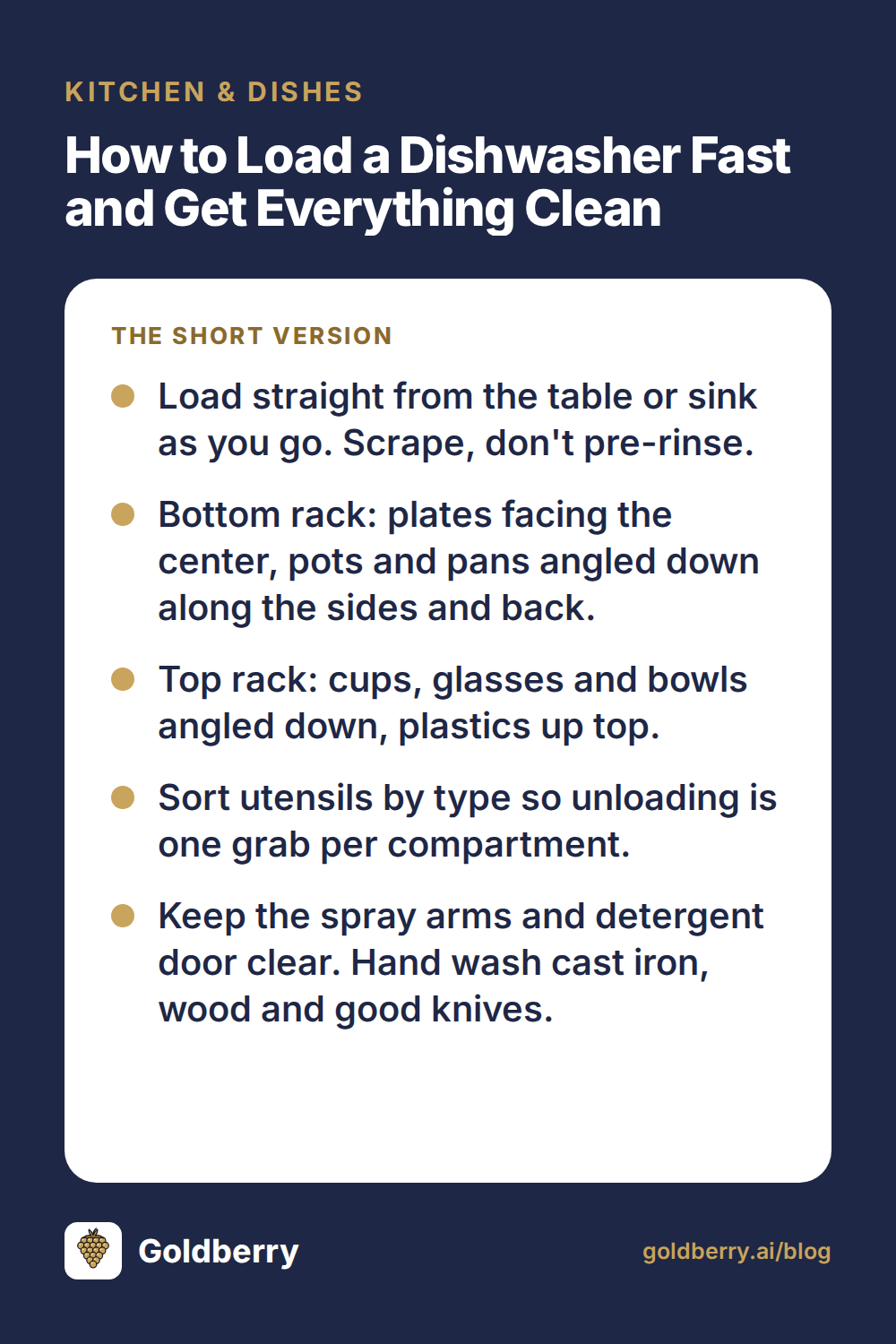
How to Load a Dishwasher Fast and Get Everything Clean
How to load a dishwasher so every dish comes out clean: what goes on each rack, which way plates face, how to sort utensils, and what to hand wash.
To load a dishwasher, scrape food into the trash, then put plates, pots and pans on the bottom rack and cups, glasses, bowls and plastics on the top rack. Face the dirty surfaces toward the spray arms, sort utensils by type in the basket, and leave room for water to reach everything.
That's the whole method. The details below make loading quicker and keep the morning unload to about 3 to 5 minutes.
Load as you go, not all at once
The fastest way to load a dishwasher is to never build a pile. When you clear a plate, scrape it and put it straight in. When you finish with a pot, it goes in too (or into the sink to soak, if it really needs it).
Loading one dish takes a few seconds. Loading a sink full of dried-on dishes takes far longer, and some of them need scrubbing.
This only works if the dishwasher is empty when the day starts. That's why it pairs so well with the habit of running the dishwasher every night and emptying it every morning.
Load in a set order
When you do load a lot at once, like after dinner, use the same order every time:
- Scrape everything into the trash or compost.
- Bottom rack first: big pots and pans along the back and sides.
- Plates in the middle of the bottom rack.
- Top rack: cups and glasses, then bowls, then plastics.
- Utensils last, sorted as you drop them in.
Big items first means you never have to pull plates back out to fit a pot.
Scrape, don't pre-rinse
Rinsing every plate under the tap feels thorough, but it mostly costs you time and water. Modern dishwasher detergents are made to break down food soil, and most machines clean scraped dishes well.
Scrape solids into the trash with a fork or spatula. Leave the sauce smears. Bones, seeds, rice clumps and stickers should come off, since they clog the filter.
Your machine's manual has the final word. Some older models do better with a light rinse. If yours says so, follow it.
Clean the filter
If dishes come out gritty, the filter is the usual cause. Many dishwashers have a removable filter at the bottom that twists out.
Check your manual for where it is and how often to clean it. Take it out, rinse it under the tap, scrub it gently with a soft brush and put it back the way the manual shows. It takes about 5 minutes.
The bottom rack: plates, pots and pans
The bottom rack gets the strongest spray, so it holds the biggest and dirtiest items.
- Plates go between the tines in the middle, dirty side facing the center of the machine (toward the spray arm). Big plates at the back, small plates in front.
- Pots and pans go along the sides and back, angled down so the inside faces the spray and water drains off.
- Baking sheets go along the sides or back edge. Never stand them across the front, where they block the detergent door.
- Plastic cutting boards go in only if they're labeled dishwasher safe. Most are too big for the top rack, so check that the label allows the bottom rack, or wash them by hand.
- Serving bowls can go on the bottom rack too, tipped down and facing the center.
Leave a little space between items. If two plates touch face to face, the water can't get between them.
The top rack: cups, glasses, bowls and plastics
The top rack is for smaller items and anything delicate.
- Cups and mugs go upside down, angled slightly so water runs off the bottom instead of pooling.
- Glasses go between the tines, not over them. A glass resting on a tine can spot or chip. Keep glasses from touching each other.
- Bowls go in rows, angled down and facing the center.
- Plastics belong on the top rack unless the label says the bottom is safe. In most machines the heating element sits at the bottom, and heat can warp plastic. Look for a "dishwasher safe" or "top rack safe" mark.
- Long utensils like spatulas and ladles lie flat on the top rack, or in the third rack if you have one.
Light plastic lids and containers tend to flip over and fill with dirty water. Wedge them between heavier items, or use clips if your rack has them.
The utensil basket: sort while you load
This is where most of the unloading time hides. If forks, spoons and knives are all mixed together, someone has to pick through the basket one piece at a time.
Sort as you load instead. Forks go in one compartment, spoons in another, butter knives in a third.
Unloading the basket becomes one grab per compartment, straight into the drawer. A sorted basket empties in under a minute.
A few rules for the basket:
- Most utensils go handles down. The eating ends sit up in the spray and come out cleaner.
- Sharp knives go point down, so nobody grabs a blade while reaching in. Better yet, hand wash your good knives.
- Don't pack spoons tight. Spoons nest, and nested spoons stay dirty. Drop them in loosely or split them across two compartments.
Fewer utensils makes all of this easier. If your drawer is always half empty while the basket is always full, try switching to one matching set of utensils.
Keep the spray arms and detergent door clear
A dishwasher cleans with spinning arms that spray water through the racks. If something blocks an arm, a whole section of the machine stays dirty.
After loading, take five seconds to check:
- Spin each spray arm by hand. It should turn without hitting anything.
- Make sure nothing hangs down through the racks, like a spatula handle or a pot handle.
- Check that the detergent door can swing fully open. A tall plate or board in front of it means the detergent never gets out.
Don't overfill, either. A packed machine that comes out half clean costs you more time than a slightly lighter load that works the first time.
What not to put in the dishwasher
Some things get damaged in a dishwasher, and a few can be ruined in one cycle. Always check the care label or the maker's instructions. Here is the usual list.
| Item | What can happen | Do this instead |
|---|---|---|
| Cast iron | Strips the seasoning and causes rust | Rinse with hot water, scrub, dry right away |
| Wooden cutting boards and spoons | Warps, cracks and splits | Wash by hand, dry standing up |
| Good kitchen knives | Dulls the edge and can damage handles | Wash and dry by hand right after use |
| Insulated mugs and bottles | Can damage the seal that keeps drinks hot or cold | Hand wash unless marked dishwasher safe |
| Some nonstick pans | Coating may wear faster | Check the label, hand wash if unsure |
| Anything marked "hand wash" | The damage the maker warns about | Follow the label |
Keep a small spot by the sink for these so they don't end up in the machine out of habit. Washing them as part of a short kitchen reset after dinner keeps them from piling up.
FAQ
Should you rinse dishes before putting them in the dishwasher?
Usually not. Pull off bones, seeds and big scraps, then load the dish as it is, since a rinse under the tap mostly adds time and water. If your manual asks for a light rinse, do what it says.
Which way should plates face in the dishwasher?
Plates should face the center of the bottom rack, toward the spray arm, so the dirty side gets the spray. Put larger plates at the back and smaller plates in front so they don't block water to each other. Leave a small gap between plates so the water can reach every surface.
Should forks go up or down in the dishwasher?
Put forks and spoons in handles down, so the parts that touched food get the most water. Sharp knives are the exception and go point down, so nobody reaches onto a blade. Sorting them by type as you go keeps the basket unload under a minute.
Why are my dishes still dirty after running the dishwasher?
The most common causes are a clogged filter, a blocked spray arm, an overloaded rack or a detergent door that can't open. Clean the filter, spin the spray arms by hand to check they turn freely, and leave space between items. If dishes still come out dirty, check your manual's troubleshooting section.
Can you put pots and pans in the dishwasher?
Many stainless steel pots and pans are dishwasher safe. Put them on the bottom rack along the sides or back, angled down so the inside faces the spray. Keep cast iron out entirely, and check the label on nonstick, copper and aluminum cookware, since a dishwasher can damage some finishes.