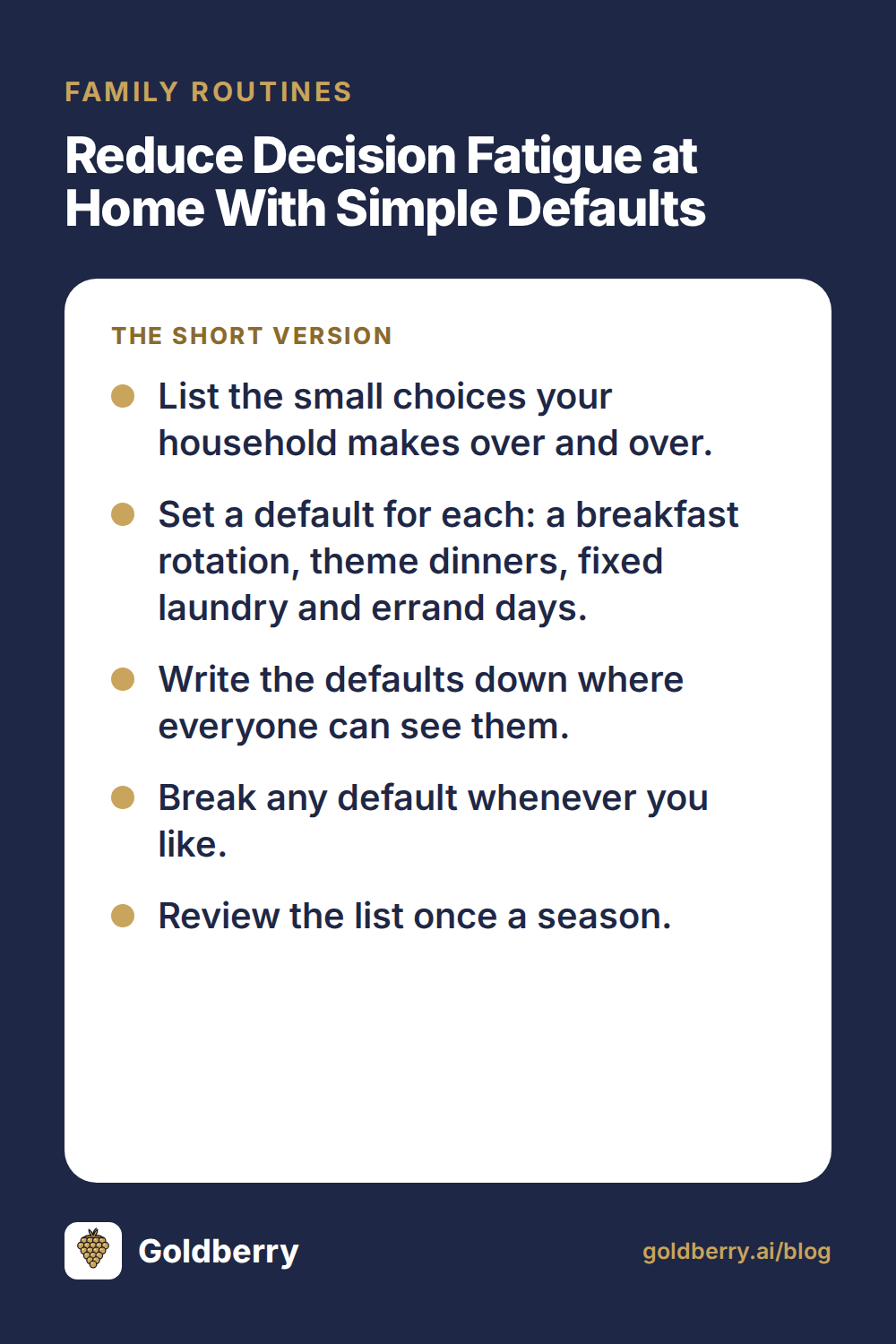
Reduce Decision Fatigue at Home With Simple Defaults
Reduce decision fatigue at home by setting defaults for meals, laundry, errands and clothes, so evenings take less thinking and anyone can run the house.
Decision fatigue at home is the worn-out feeling that builds from dozens of small daily choices: what's for dinner, what to wear, when to do laundry. The fix is to set defaults, so you make each of those choices once and then stop making it every day.
How decision fatigue works is still debated, and you don't need to settle it. Anyone who has stared into an open fridge at 6 p.m. knows the feeling. Fewer small choices make evenings easier, and that is reason enough.
Why small choices add up
No single choice is hard. Picking dinner takes a minute, and so does picking a shirt.
The trouble is volume. A household produces these choices all day, for every person in it, and each one adds a little friction.
That friction shows up as stalling. You open the fridge, close it and order takeout. Laundry waits for "later" because nobody picked a day, and kids ask the same question every night because the answer keeps changing.
A default removes the choice without removing your freedom. You can still have tacos on Monday instead of Tuesday. You just don't start from zero every time.
Make a list of your repeat decisions
Spend two or three days noticing the questions that come up again and again. Keep a note on your phone and jot one down every time someone (including you) stalls on a small choice. It adds up to about 10 minutes of effort.
Most lists look something like this:
- What's for breakfast?
- What's for dinner tonight?
- What do we need from the store?
- When does laundry get done?
- What am I wearing tomorrow?
- Where are my keys?
- Can I have a snack, screen time or a friend over?
- When do we run errands?
Circle the three that cause the most friction and start there. Once those defaults are working, add more.
Set food defaults first
Food is where most families feel decision fatigue the hardest. It comes up three times a day, and everyone has an opinion.
A breakfast rotation
Pick three to five breakfasts your household likes and rotate through them. Oatmeal on Monday, eggs on Tuesday, yogurt and fruit on Wednesday, and so on. Or keep it even simpler: cereal or toast on weekdays, something cooked on weekends.
Shopping gets easier too, because you buy the same breakfast items every week.
Theme dinner nights
With a theme for each night, nobody has to pick dinner from every meal they know. On pasta night, the only thing left to settle is the sauce.
One week might run pasta on Monday, tacos or wraps on Tuesday, a sheet pan dinner on Wednesday and soup, stew or chili on Thursday. Friday is pizza or takeout, Saturday clears out the fridge, and Sunday is for something slow, like a roast, the slow cooker or the grill.
Fill in the actual meals during a short weekly plan. If you want a fast method, here is how to plan a week of meals in 10 minutes.
A restock rule for staples
Most households buy many of the same things every week: milk, bread, eggs, pasta, coffee. Rather than deciding each week whether you need them, give each staple a minimum and let that make the call.
Here is how to restock staples when they hit a set minimum, with no weekly pantry count. It saves time in the store and money on extra trips for the thing you forgot.
Set defaults for clothes, chores and errands
The same approach works anywhere a task repeats.
Laundry days. Pick fixed days, like Wednesday and Sunday, or run one load every day. Either works, as long as nobody has to decide when. If you're not sure which fits your house, compare laundry day vs a load a day.
Errand day. Batch errands into one trip on the same day each week. Saturday morning is common. The post office, pharmacy, returns and dry cleaning all wait for errand day unless they are urgent.
A weekday uniform. Pick a few go-to outfits and rotate them on weekdays, like jeans and a sweater, or dark pants and a plain top. Morning choices drop to almost nothing. For kids and adults alike, it helps to plan outfits for the week on Sunday.
Give things a home and questions an answer
Some of the most draining decisions are really searches: for keys, for the backpack, for the permission slip that was on the counter this morning. Others are the same questions asked every single day.
One place for keys and bags. Put a hook, a bowl or a small shelf by the door. Keys, wallets, backpacks and the dog leash go there every time. This one default saves a few minutes on most mornings.
A default answer for recurring asks. Decide the house answer once:
- Snacks: one after school, from the snack basket.
- Screens: after homework, until dinner.
- Friends over: yes on weekends, ask first on school nights.
- Bedtime: the same time on school nights, an hour later on weekends.
When the answer is the same every time, the asking slows down. You also stop negotiating at the end of a long day.
Decisions and their defaults at a glance
| Daily decision | Default |
|---|---|
| What's for breakfast? | A rotation of 3 to 5 favorites |
| What's for dinner? | Theme nights, filled in once a week |
| What do we need from the store? | Staples restocked at a set minimum, plus the week's meals |
| When do we shop? | One set grocery day |
| When does laundry happen? | Fixed laundry days, or one load a day |
| What am I wearing? | A weekday uniform, or outfits picked on Sunday |
| Where are my keys? | One hook or bowl by the door |
| When do we run errands? | One trip, same day each week |
| Can I have screen time? | One standing rule everyone knows |
| What gift do we bring? | A go-to gift kept on hand |
The gift default is an easy money saver. Buy a few books or craft kits when they are on sale, and you skip the last-minute store run before every birthday party.
Write the defaults down
A default that lives only in your head leaves the house when you do. Write it down so anyone can follow it.
Keep it short. One page on the fridge or one shared note is plenty. Include:
- The breakfast rotation and dinner themes.
- Laundry, grocery and errand days.
- Where things live: keys, bags, chargers, spare batteries.
- The house answers to recurring asks.
Share it with your partner, a babysitter or a grandparent who helps out. When someone else can run the house for a day without texting you twenty questions, the defaults are doing their job.
Review once a season
Defaults go stale. Kids outgrow a breakfast, practice moves to Tuesdays, and the weather changes what anyone wants for dinner.
Four times a year, take about 15 minutes to look at the list. Keep what works, drop what nobody follows, and add a default for any new friction point. The start of the school year and the start of summer are natural times to do it.
Skip taco night when you feel like it. The point is that you don't have to think about dinner on the nights you don't want to.
FAQ
What is decision fatigue at home?
It's the tired, stuck feeling that comes from making many small choices every day for yourself and your family: meals, clothes, chores, schedules and permissions. The exact cause is still debated, but the everyday experience is familiar. By evening, even easy choices feel hard, which is when takeout, skipped chores and short tempers tend to show up.
How do I reduce decision fatigue at home?
Pick the three repeat choices that cause the most friction and give each one a default, like a breakfast rotation, theme dinner nights or a fixed laundry day. Put the defaults in writing so anyone in the house can follow them. Revisit them each season and drop the ones nobody uses.
Won't defaults make life boring?
Not really. Theme nights still leave room for plenty of different meals, and you can break any default when you feel like it. With the routine choices handled, you have more room for the ones you actually care about.
What are good daily routines for families?
Good family routines are simple and happen the same way each day: a breakfast rotation, a set after-school order (snack, homework, then screens), theme dinners, a fixed bedtime on school nights and a quick evening tidy. Write them down and keep them visible, so kids can follow them without asking every time.