Laundry Day vs a Load a Day: Which Saves More Time?
Load a day laundry or one laundry day? Compare time, how the house looks and who each suits, plus a hybrid schedule that keeps clean clothes out of baskets.
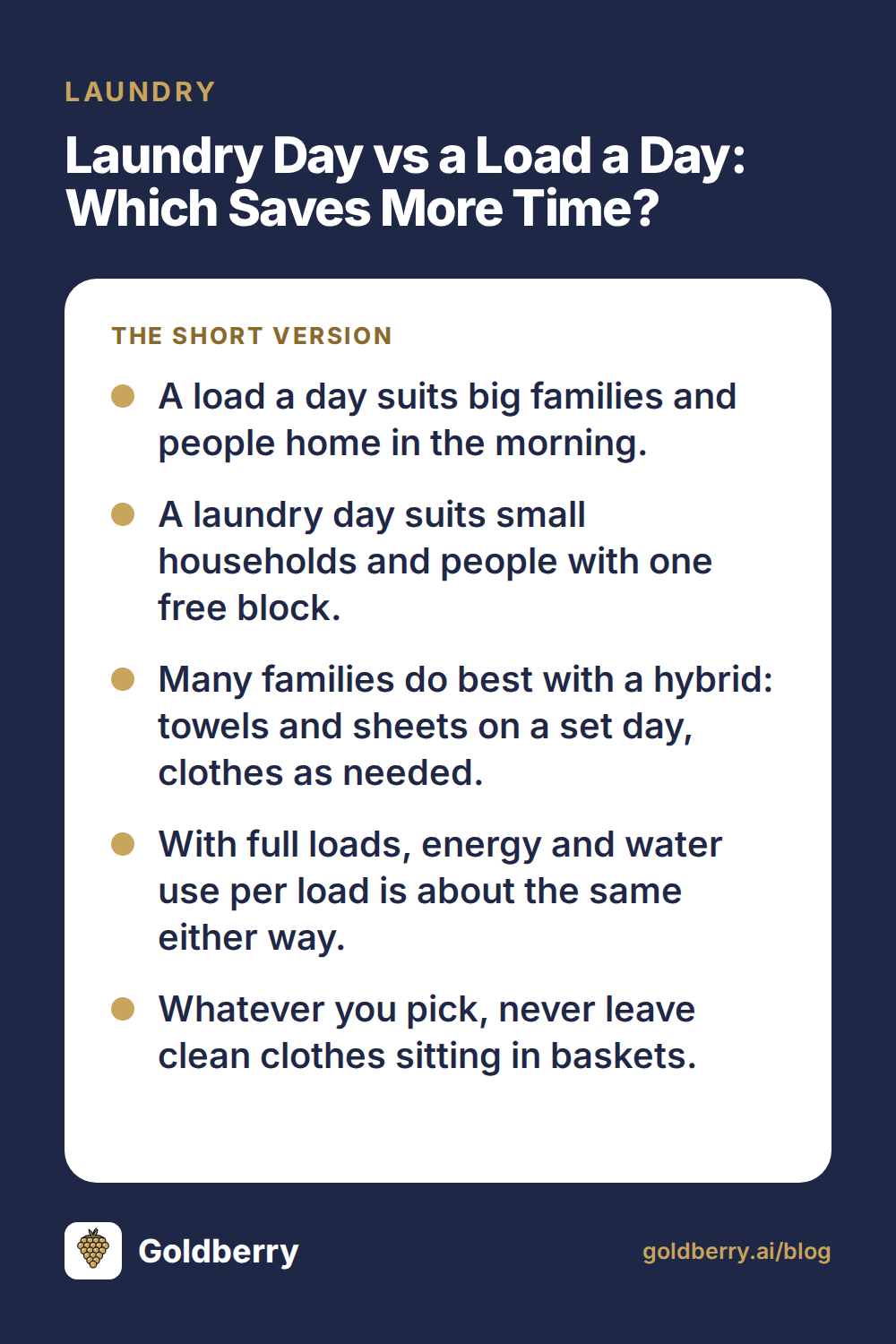
Neither a laundry day nor a load a day saves much hands-on time, since each load takes about the same work either way. They differ in when that work happens and how the house looks between washes, so pick by your household: a load a day suits big families and people home in the mornings, and a laundry day suits smaller households and people with one free block of time.
The better method is the one you'll actually keep doing. Whichever you choose, finish each load the same day: washed, dried, folded and put away.
How a load a day works
You run one load every day, start to finish. The pile never gets big, and laundry becomes a small habit instead of a big chore.
A typical day looks like this:
- Start the washer before breakfast, or set the delay-start so it finishes when you get home.
- Move it to the dryer, timed so someone is home when it stops.
- Fold and put it away as soon as the dryer finishes, about 15 minutes of work.
The catch is that it has to be a full load. If your household only fills three or four loads a week, running small loads every day tends to use more water and energy over a week than fewer full ones.
How a laundry day works
You pick one day, or one long block, and do the week's laundry back to back. While the machines run, you're free for other things at home.
A typical laundry day:
- Start the first load early, and start the next one as soon as the washer frees up.
- Fold each load as it comes out of the dryer, instead of saving it all for the end.
- Put each load away before the next one finishes.
The risk is the end of the day. Four or five clean loads dumped on the bed at 9 p.m. is how the clean laundry mountain starts. Folding as you go prevents it.
Side-by-side comparison
| Load a day | Laundry day | |
|---|---|---|
| Hands-on time | About 15 minutes a load, spread out | About 15 minutes a load, all in one block |
| Time tied to the house | Little, with delay-start | A half day or more |
| How the house looks | Hampers stay low, no big piles | Hampers fill up through the week |
| Energy and water per load | Same, if loads are full | Same, if loads are full |
| Common failure | A forgotten load sits wet in the washer | Ending the day with unfolded baskets |
| Best for | Big families, people home in the morning | Small households, one free block a week |
Who a load a day suits
- Families of four or more, who fill a load most days anyway
- Parents who are home in the morning, or who have a washer with delay-start
- Homes with small laundry spaces and no room for piles of dirty clothes
- Households where older kids each run their own load on their own day
It pairs well with one hamper per person: each day is one person's hamper, so nothing needs sorting. That's the core of a simple family laundry system.
Who a laundry day suits
- Singles, couples and small families who fill two to four loads a week
- People who work long days and have one free morning or evening
- Anyone who likes to batch chores and be done for the week
- Homes that use a shared laundry room or laundromat, where every trip takes time and money
If you like grouping chores, laundry day fits next to other weekly jobs like the grocery run and a quick clean. See how to batch household tasks for more on that approach.
The hybrid many families end up with
A lot of households land somewhere in between. It's easy to set up:
- Towels and kitchen cloths on one set day each week
- Sheets from every bed on another set day, every week or two
- Clothes washed as hampers fill, one person's hamper per load
This keeps the bulky, slow-drying loads off busy weekdays and keeps clothes from piling up. It also takes care of lint, because towels never share a load with dark clothes.
How to pick
Answer three questions honestly:
- How many full loads does your household make in a week? Four or fewer points to a laundry day. Five or more points to a load a day, at least on weekdays.
- When are you home? Mornings and evenings at home favor a load a day. One free block favors a laundry day.
- What do you tend to skip? If you put off big jobs, one load a day is easier. If daily habits slip, one set day is easier to protect.
Try one method for a few weeks, then switch if it isn't working. Put the schedule on your shared family calendar so everyone knows which day is whose.
Never leave clean clothes in baskets
Whichever method you pick, the weak spot is the gap between the dryer and the dresser. Clean clothes parked in a hallway basket turn into a second dresser that everyone digs through.
Close that gap by folding as soon as the dryer finishes and walking each person's stack to their room on the same trip. It all goes faster when you fold less in the first place.
FAQ
Is a load a day better than one laundry day?
Neither is better for everyone. A load a day suits larger families and people home in the morning, while a laundry day suits smaller households and people with one free block of time. Hands-on time per load is about the same, so pick the one you'll keep doing.
How often should you do laundry?
Often enough that hampers don't overflow and nobody runs out of clean clothes. For a single person or a couple, that's usually once or twice a week, while families of four or more often need a load most days. Many households wash towels weekly and sheets every week or two, each on its own day.
Does a load a day use more water and electricity?
Not if each load is full. Running the same number of full loads costs about the same whether you do them daily or all at once. The waste comes from running half loads just to keep the habit, so if you can't fill one every day, go every other day.
What is the one load a day method?
It means washing, drying, folding and putting away one full load every day, start to finish. Most people start the washer in the morning or set it to finish when they get home, run the dryer while someone is around, and fold the moment it stops. The goal is that laundry never piles up and never takes more than about 15 minutes of hands-on time at once.