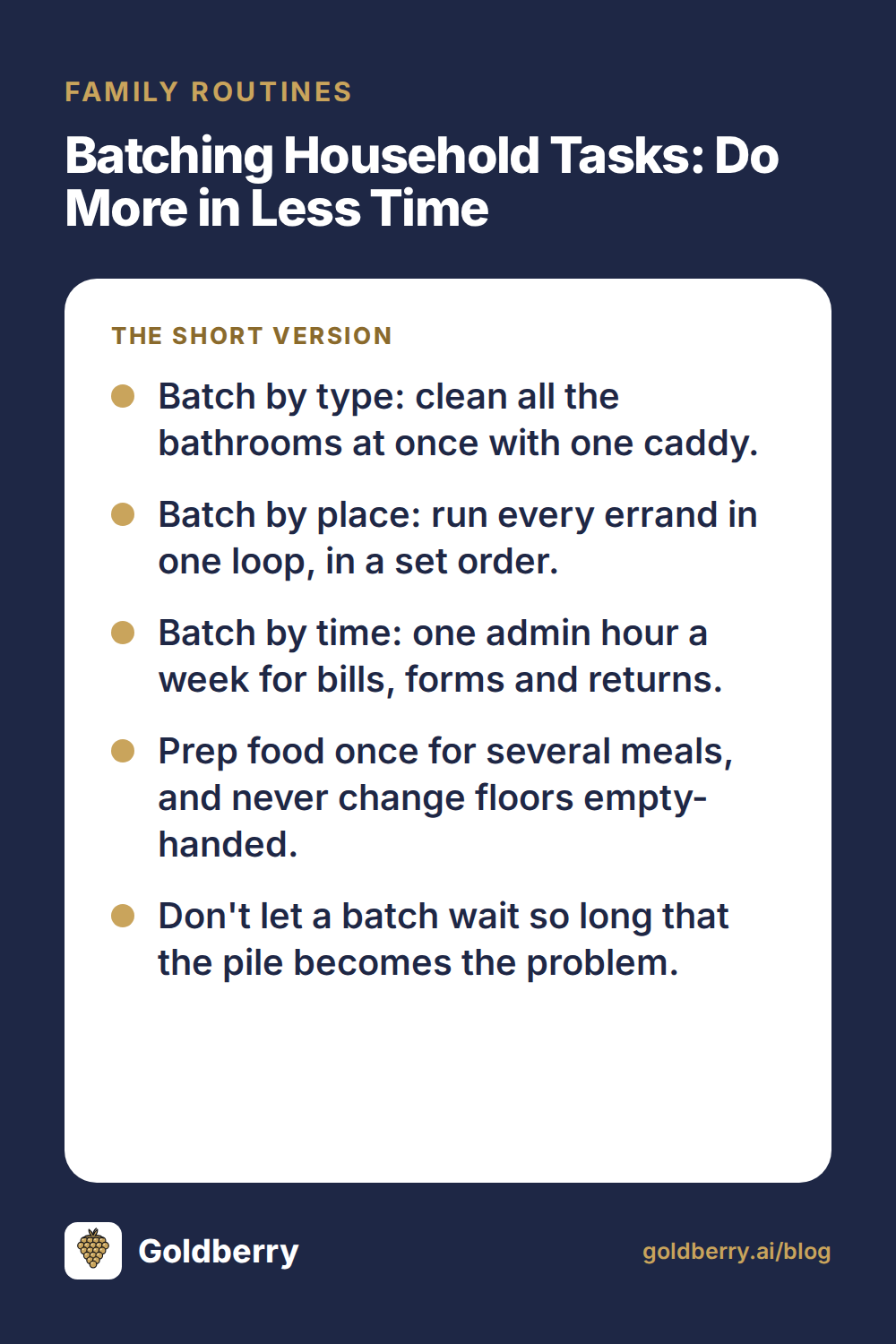
Batching Household Tasks: Do More in Less Time
Batching household tasks means grouping similar chores so you set up once and keep moving. How to batch by type, place and time, plus a sample weekly plan.
Batching household tasks means doing similar jobs together in one session instead of scattering them across the week. You get the supplies out once, stay in one place and keep a rhythm going, so the same work takes less time.
A lot of the time a chore takes isn't the chore itself. It's finding the spray, walking to the other bathroom and getting going again after a break. Batching cuts much of that out.
Why switching between jobs costs you time
Every chore has a start-up cost and a wind-down cost. You get the supplies out, walk to the spot, remember where you left off, then put everything away again.
Clean one bathroom on Tuesday and another on Friday, and you pay those costs twice. Clean both on Monday with one caddy, and you pay them once.
The hidden costs add up:
- Getting out supplies. Finding the cleaner, the cloths, the brush, the gloves.
- Walking. Back and forth between rooms, up and down stairs, out to the car.
- Starting and stopping. Every restart takes a minute or two to get back into the job.
- Deciding. Each new task means deciding what to do and how.
Batching won't make scrubbing a tub any faster. It removes the extra minutes around the scrubbing.
Batch by type: one job, every room
Do the same job everywhere in one go. Bathrooms are the classic example.
- Fill one caddy with everything: cleaner, toilet brush, cloths, gloves and a trash bag.
- Go to the first bathroom and clean in the same order every time (mirror, sink, counter, toilet, floor).
- Carry the caddy to the next bathroom and repeat the same order.
- Put the caddy away once.
The second and third bathrooms go faster than the first, because you're already in the rhythm. There's no walk back to the supply closet, either.
Other jobs that batch well by type:
- Dusting every room with one cloth on one route.
- Stripping every bed on the same day every week or two, and washing the sheets as their own load.
- Watering every plant in one pass through the house.
- Emptying all the small trash cans into one bag on trash night.
To give each of these a regular slot, set up a simple cleaning schedule built around your batches.
Batch by place: one errand loop
Errands cost you most of their time in driving and parking. Three errands on three days means three round trips. Three errands in one loop means one.
Pick one time each week for errands and run them in an order that makes sense for your area:
- The farthest stop first, so you work your way back toward home.
- Stops without food in the middle: pharmacy, post office, returns, hardware store.
- Groceries last, so cold food goes straight home to the fridge.
Keep a running list through the week. When something comes up on Tuesday, it goes on the list for errand day instead of becoming its own trip. Ending the loop at the grocery store works best if you already grocery shop once a week.
There's a money side too. Fewer trips means less gas, and fewer quick runs to the store means fewer impulse buys.
Batch by time: the weekly admin hour
Household paperwork is the worst kind of chore to do in scraps. A bill here, a permission slip there, a return label half printed. Each one interrupts something else.
Give it one fixed hour a week instead. Sunday evening or a weekday lunch break works for a lot of people. In that hour:
- Pay bills and check your accounts.
- Fill in forms and permission slips, and book appointments.
- Print return labels and pack returns for errand day.
- Answer the emails and messages you've been putting off.
- Sort the mail pile.
During the week, anything admin goes into one spot: a tray on the counter, a folder or a note on your phone. It waits there until admin hour, so you stop handling the same piece of paper five times.
Paying bills on a set day each week also helps you catch due dates before they turn into late fees.
Batch your cooking prep
Cooking is one of the easiest places to batch. Chopping one onion takes almost as much setup and cleanup as chopping three.
When you plan meals for the week, look for overlap. If three dinners use onions, peppers and carrots, chop them all in one session and store them in containers in the fridge. Cook a big pot of rice or grains once and use it for two or three meals.
A simple prep session looks like this:
- Wash and chop the vegetables for the week's meals.
- Cook one batch of grains and one batch of protein.
- Portion snacks or lunches into containers.
- Wash the cutting board and knives once.
Refrigerate cooked grains and protein within 2 hours, and use them within 3 to 4 days. Plan the meals first so you know what to prep. A quick meal plan in 10 minutes makes the overlap easy to spot.
The one-trip rule
The one-trip rule is the smallest batch of all: never go to another room or floor empty-handed.
Keep a basket at the bottom of the stairs. Shoes, toys, folded laundry and anything else that belongs upstairs goes in it.
Every time someone heads up, they carry the basket or a few things from it. Do the same in reverse at the top.
The same idea works all over the house:
- Clearing the table: take the plates and the salt and pepper in one trip.
- Getting out of the car: bring everything in, not just your bag.
- Taking out the trash: grab the recycling too.
None of these saves much on its own. Over a week, they replace a whole tidy-up session.
A sample weekly batching plan
Here's one way to lay out a week. Move the days around to fit your schedule.
| Day | Batch | What's in it | About |
|---|---|---|---|
| Monday | Bathrooms | All bathrooms with one caddy | 20 to 30 minutes |
| Tuesday | Kitchen | Toss old leftovers from the fridge, wipe cabinet fronts | 20 minutes |
| Wednesday | Dusting and vacuuming | Every room, one route | 30 to 45 minutes |
| Thursday | Errands | One loop, groceries last | About 1 hour |
| Friday | Off | Daily tidy only | None |
| Saturday | Laundry and beds | Wash, dry and fold; every week or two, strip all the beds and wash the sheets as their own load | 1 to 2 hours, mostly waiting |
| Sunday | Admin and food prep | Bills, forms and returns, then prep for the week | 1 to 2 hours |
Keep daily jobs like dishes and wiping the counters outside the plan. They don't batch well, because they can't wait.
When batching backfires
Batching works because you wait until there's enough of a job to make the setup worth it. Wait too long, and the pile becomes the problem.
Watch for these signs:
- Things run out before batch day. If you're out of clean towels by Thursday, one laundry day isn't enough. Compare laundry day vs a load a day to see which fits your house.
- Small jobs turn into big ones. A spill left for cleaning day gets sticky. Wipe it now.
- The batch is too big to finish. If a session eats the whole afternoon and you dread it, split it into two smaller batches.
- Deadlines slip. A form due Wednesday can't wait for Sunday's admin hour. Do it when it lands.
A good rule of thumb: if a job takes under two minutes and waiting will make it worse, do it now. Batch the rest.
FAQ
What does it mean to batch household tasks?
It means grouping chores that share supplies, a location or a kind of thinking, then doing them back to back. Wiping down every bathroom with one caddy is a batch, and so is a single loop for the week's errands. You set up once and pack up once, instead of every time.
Which chores are easiest to batch?
Cleaning bathrooms, dusting, changing beds, laundry, errands, paperwork and food prep all batch well. They share supplies or a location, and most only need doing once or twice a week. Daily jobs like dishes, spills and taking out a full trash bag don't batch well, because waiting makes them worse.
How do I start batching chores?
Pick one batch and give it a fixed day, like errands on Thursday or bills on Sunday evening. Keep a running list during the week so tasks wait for their batch instead of getting done in scraps. Once that first batch feels automatic, add a second one, then build from there.
Is batching better than doing a little every day?
Jobs with a lot of setup, like cleaning bathrooms or paying bills, go faster in batches. Jobs that get worse when left, like dishes, spills and trash, are better done daily. Most homes run best on a mix of small daily habits and a few weekly batches.