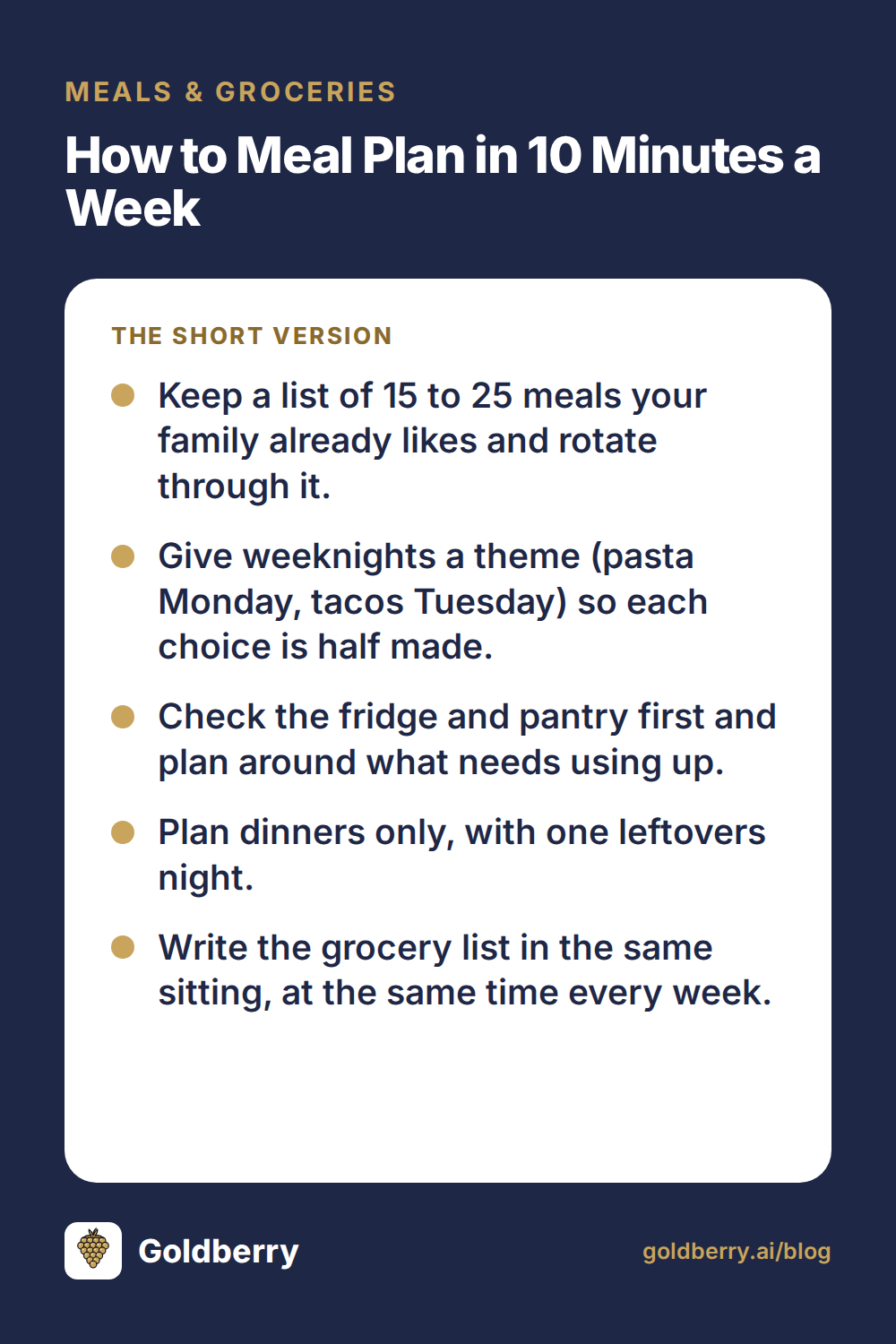
How to Meal Plan in 10 Minutes a Week
Quick meal planning for busy families: rotate meals you already like, use theme nights, and write the grocery list in the same 10 minutes each week.
To meal plan in 10 minutes, stop starting from scratch every week. Keep a running list of 15 to 25 dinners your family already eats, give each weeknight a theme, and fill the week from that list in one short sitting, writing the grocery list as you go.
The slow part of meal planning is the deciding, not the writing. Once the big decisions are made ahead of time, the weekly part shrinks to checking the fridge, picking, and making a list.
Build a master list of meals your family already eats
This is the one-time step that makes every week fast. It takes about 30 minutes once, then a minute here and there to keep it current.
Write down every dinner your household eats without complaint. Skip the aspirational meals and the recipe you saved last month. List the ones that actually get made and actually get eaten.
Aim for 15 to 25. Fewer than 15 and the rotation starts to feel repetitive. More than 25 and you are back to scrolling through too many options.
Some ways to fill the list:
- Look back over the last two or three weeks of dinners.
- Ask everyone at the table for their two favorites.
- Include the easy fallbacks: breakfast for dinner, grilled cheese and soup, frozen pizza.
- Note the main ingredients next to each meal, so you can scan for what uses up the chicken or the spinach.
When you try a new recipe and it's a hit, add it. When something keeps getting skipped, cross it off. The list stays useful without much upkeep.
Use theme nights so the decision is half made
A theme turns "what's for dinner?" into "which pasta?" That's a much smaller question, and it's the one that saves the most time.
Pick a theme for each weeknight that fits the meals on your list. Keep themes broad so they work with what's in season and what's on sale. A typical setup looks like this:
- Monday: pasta
- Tuesday: tacos or wraps
- Wednesday: sheet pan dinner
- Thursday: soup, stew or chili
- Friday: pizza or takeout
- Saturday: clean out the fridge
- Sunday: something slow (a roast, the slow cooker, the grill)
Treat the themes as a starting point. If Tuesday gets busy, swap it with a lighter night, and if your family hates soup, pick a different theme.
What matters is that each night already has a shape before you sit down to plan.
Shop your fridge and pantry first
Before you pick anything, spend about two minutes looking in the fridge, freezer and pantry. You are looking for what needs to be eaten soon and what you already have plenty of.
- Open the fridge and note produce, dairy and leftovers that need using in the next few days.
- Check the freezer for meat or backup meals you can build a night around.
- Glance at the pantry for staples you have plenty of, like pasta, rice, beans and canned tomatoes.
- Match those items to meals on your list and slot them in first.
This is where planning saves money as well as time. Food you already bought becomes dinner instead of trash, and the grocery list gets shorter.
If you keep minimums for your staples, this step gets even faster because you already know what's in the house. Here's how to set up a pantry inventory with par levels.
Plan dinners only, and keep one leftovers night
Start with dinners. Breakfasts and lunches tend to repeat on their own, and planning them adds time without saving much. Once dinners feel automatic, you can add other meals if you want to.
Plan five or six dinners, not seven. Leave one night for leftovers or a "clean out the fridge" meal. That night catches whatever didn't get eaten, which cuts waste and gives the cook a break.
Good clean-out meals:
- Fried rice with leftover vegetables and protein
- Omelets or a frittata
- Quesadillas or wraps
- Grain bowls with whatever is in the fridge
- A snack plate dinner of cheese, crackers, fruit and cut vegetables
Put this night late in the week, but not too late. Most cooked leftovers keep about 3 to 4 days in the fridge, so toss anything older than that or anything that smells off. When in doubt, throw it out.
A sample week
Here's what a finished plan can look like for a family of four. Each line took a few seconds to pick because the theme and the fridge did most of the work.
| Day | Dinner | Why it's on the plan |
|---|---|---|
| Sunday | Roast chicken, potatoes, green beans | Makes extra chicken for Monday |
| Monday | Pesto pasta with leftover chicken | Pasta night, uses Sunday's chicken |
| Tuesday | Beef tacos with lettuce and salsa | Taco night, ground beef from the freezer |
| Wednesday | Sheet pan sausage and vegetables | Uses peppers and zucchini before they soften |
| Thursday | Chili with cornbread | Pantry beans and canned tomatoes, makes extra |
| Friday | Homemade pizza | Easy end-of-week night |
| Saturday | Clean out the fridge | Leftover chili, fried rice or omelets |
Notice that two meals are planned to make extra. Cooking once and eating twice is one of the easiest ways to buy back time midweek.
Write the grocery list in the same sitting
Don't close the plan and come back to the list later. Do it right then, while the meals are fresh in your head.
- Go meal by meal and write down each ingredient you don't already have.
- Add any staples that are running low.
- Group the list by store section: pantry and household first, then produce, with meat, dairy and frozen last so cold food spends the least time in the cart.
- Put it somewhere the whole household can see it and add to it.
Grouping by section means one pass through the store with no doubling back. If you want fewer trips overall, pair this with shopping once a week.
Pick the same 10-minute slot every week
A fixed time beats a good intention. Choose one slot and protect it: Sunday morning with coffee, Saturday after breakfast, or the evening before you shop.
Here's roughly how the 10 minutes break down:
- Check the fridge, freezer and pantry (about 2 minutes).
- Pick dinners from your list using the themes (about 4 minutes).
- Write the grocery list (about 3 minutes).
- Share the plan and list with the household (about 1 minute).
The first few weeks may take 15 to 20 minutes while you build the list and settle on themes. After that, it gets close to 10.
You also get back something harder to measure: no more standing at the open fridge at 5 p.m. trying to decide. If that end-of-day fog sounds familiar, these ideas for cutting decision fatigue at home help well beyond dinner.
FAQ
How many meals should be on a family meal rotation?
Somewhere between 15 and 25 dinners works for most families. That's enough variety that the same meal comes around only every few weeks, and short enough to scan in a minute. Start with what you already cook, then add new recipes only after they've been a hit at least once.
What is the easiest way to start meal planning?
Plan dinners only, for five or six nights, using meals you already know how to make. Check the fridge first, keep one leftovers night, and write the grocery list right away. Skip new recipes, breakfasts and lunches until the habit sticks, and it usually starts to feel easy within a few weeks.
Does meal planning really save money?
It usually does, mostly by cutting waste and extra trips. Planning around what's already in the fridge means less food goes bad, and shopping from a list means fewer impulse buys. The time savings tend to show up first, though: no nightly debates and fewer last-minute runs to the store.
What if the meal plan falls apart midweek?
Swap nights instead of starting over. Move Thursday's meal to Wednesday, pull the leftovers night earlier, or grab a backup meal from the freezer. Keeping two or three easy fallback dinners on hand, like pasta with jarred sauce, eggs and toast, or a frozen soup, means a busy night doesn't turn into takeout by default.