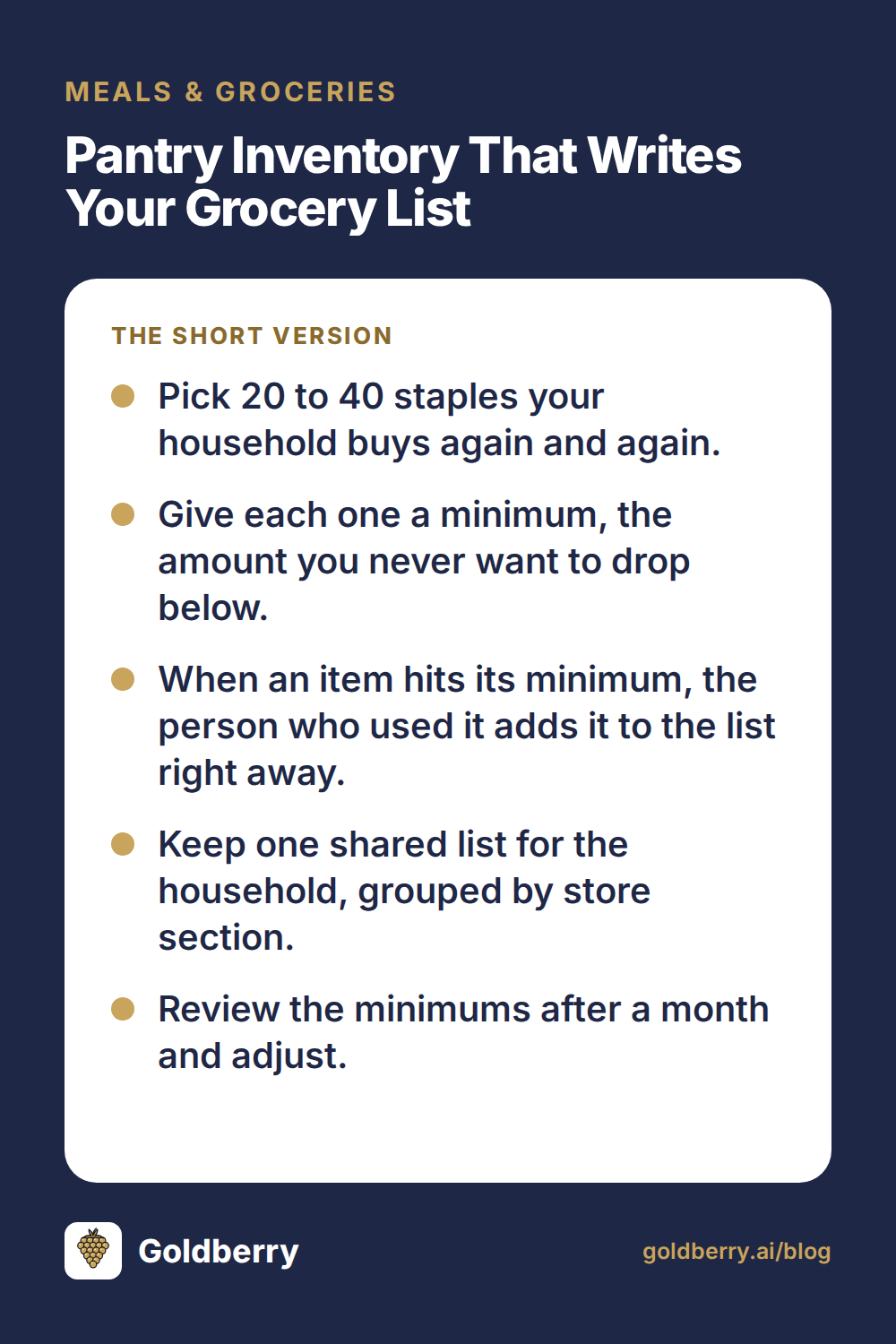
Pantry Inventory That Writes Your Grocery List
Set par levels for 20 to 40 pantry staples and your grocery list fills itself in as you cook. A simple pantry inventory so you never run out.
The simplest pantry inventory is a short list of staples, each with a par level: the minimum amount you always want in the house. When an item drops to its minimum, whoever used it adds it to the shared grocery list right away, so the list is mostly written before you sit down to shop.
Restaurants have run their stockrooms this way for a long time. It works just as well at home, takes about an hour to set up once, and saves you from the "we're out of eggs again" trip.
What a par level means at home
In a restaurant, a par level is how much of something needs to be on the shelf to get through until the next delivery. At home, you only need the simple version: a minimum.
The minimum is the trigger. Once you are down to it, the item goes on the list. You still have enough to get by until your next shopping trip, so you never actually run out.
For example, say your minimum for pasta is two boxes. When you open a box and see only two left in the cupboard, pasta goes on the list. You'll buy more on your next trip, and you'll still have pasta for dinner in the meantime.
This replaces the full pantry count. You don't need to know exactly how many cans of beans you own. You only need to notice when a staple crosses its line.
Choose 20 to 40 staples
Start with the things you buy over and over and would be annoyed to run out of. Most households land somewhere between 20 and 40 items.
Walk through the kitchen with a notepad. It takes about 15 minutes. Look in these places:
- Fridge: milk, eggs, butter, cheese, yogurt, condiments you use weekly
- Pantry: pasta, rice, canned tomatoes, beans, oil, flour, sugar, cereal, coffee
- Freezer: frozen vegetables, bread, chicken or ground meat
- Under the sink and in closets: dish soap, dishwasher detergent, paper towels, toilet paper, trash bags
Leave out things you buy for a single recipe. Fresh produce and one-off ingredients come from your weekly meal plan instead.
Staples are the base, and the plan fills in the rest. If you don't have a plan yet, here's how to meal plan in about 10 minutes a week.
Set sensible minimums
A good minimum is roughly what you use before your next shopping trip, plus a small cushion. If you shop weekly, think "how much do we go through in a week?"
The table below is sized for a family of three or four who shops once a week, so each minimum covers about a week of use. For a household of two, roughly halve the fresh items like milk, eggs and bread.
| Staple | Minimum on hand | Add it to the list when |
|---|---|---|
| Milk | 2 gallons | You're down to two gallons |
| Eggs | 1 dozen | You're down to one carton |
| Butter | 1 package | You open the last package |
| Bread | 2 loaves (frozen counts) | Two loaves are left |
| Pasta | 2 boxes | Two boxes are left |
| Rice | 1 bag | You open the last bag |
| Canned tomatoes | 3 cans | Three cans are left |
| Canned beans | 3 cans | Three cans are left |
| Cooking oil | 1 bottle | You open the last bottle |
| Coffee or tea | 1 bag or box | You open the last one |
| Cereal or oats | 2 boxes | Two boxes are left |
| Frozen vegetables | 2 bags | Two bags are left |
| Dish soap | 1 bottle | You open the last bottle |
| Toilet paper | 1 pack | You open the last pack |
| Trash bags | 1 box | You open the last box |
For anything you use one at a time, like oil or dish soap, the pattern is the same: keep one open and one sealed. When you open the sealed one, it goes on the list.
Add it the moment it hits the minimum
This is the habit that makes the whole system work. The person who takes an item down to its minimum adds it to the list, right then, before the container goes back on the shelf.
Not later, and not by texting someone else to do it. It takes about five seconds, and it means nobody has to do a big count before shopping.
A few things that help it stick:
- Put the list where people already look, like their phones or a notepad on the fridge.
- Mark the minimum on the shelf or bin with a small label, so nobody has to remember the number.
- Make it a household rule for everyone old enough to read. Kids can do this early, and it fits well with other age-appropriate chores.
- Thank people when they do it. It sounds small, but it keeps the habit going.
Keep one shared list, not a string of texts
Texts get buried. Two people buy the same thing, or nobody buys it because each person assumed the other saw the message.
Use one list that the whole household can see and add to. A shared list on everyone's phone works well, because it's with you at the store. A paper list on the fridge works too, if someone remembers to take a photo of it before leaving.
Whatever you use, there should be exactly one. When someone asks "is it on the list?", there's only one place to look.
Keep staples in the same spot
A pantry inventory works best when a glance tells you the count. That only happens if each staple always lives in the same place.
- Give each staple a home and keep it there. Pasta on one shelf, canned goods on another.
- Keep backups together, in a bin or at the back of the shelf, so you can see how many are left.
- Put new purchases behind the older ones so the oldest gets used first.
- Use clear containers or open bins for things like rice and oats, so you can see the level.
You don't need a matching pantry makeover. A couple of bins and a habit of putting things back in the same spot are enough. Unpacking groceries takes about the same time either way.
Group the list by store section
A list in random order sends you back and forth across the store. Grouping by section lets you make one pass.
Use sections that match the store you shop at most. Order them so shelf-stable and household items come first and cold food comes last, which keeps meat, dairy and frozen food in the cart for the shortest time:
- Household and cleaning
- Pantry and canned goods
- Bakery and bread
- Produce
- Meat and fish
- Dairy and eggs
- Frozen
If your list tool lets you assign sections, set each staple's section once and it will sort itself from then on. A sorted list saves backtracking and makes it much easier to shop just once a week.
Review your minimums after a month
Your first minimums are guesses. After about four weeks, spend 10 minutes looking at what happened.
- You ran out of something: raise its minimum.
- Something piled up or expired: lower its minimum, or drop it from the staples list.
- You kept buying something that isn't on the list: add it as a staple.
- An item rarely moves: take it off and buy it only when a recipe calls for it.
After that, a quick check every few months is plenty. Adjust for seasons too. You'll likely go through more soup and baking supplies in winter and more snacks and drinks in summer.
FAQ
What is a par level at home?
It's the smallest amount of a staple you're willing to have in the house, like two boxes of pasta or a dozen eggs. Reaching that amount is the cue to put the item on the grocery list. Because the minimum is sized to cover the days until your next shop, the new supply arrives before the shelf goes bare.
How do I keep a pantry inventory without counting everything?
Track only your 20 to 40 regular staples, and give each one a minimum. Keep every staple in the same spot so you can see the count at a glance. When something drops to its minimum, add it to the list right away, which turns a full count into a five-second habit.
What should be on a pantry staples list?
Start with what your household uses every week: pasta, rice, canned tomatoes, beans, oil, flour, coffee, cereal, eggs, milk, butter, bread and frozen vegetables. Add household basics like dish soap and toilet paper, and leave off ingredients you buy for one recipe. The right list is personal, so build it from what you actually use.
How do I get my family to add things to the grocery list?
Make it one rule: whoever takes an item down to its minimum adds it, right then. Keep one shared list that everyone can reach, and label minimums on shelves so nobody has to remember numbers. Kids can learn this early, and a quick thank-you goes a long way toward making it stick.