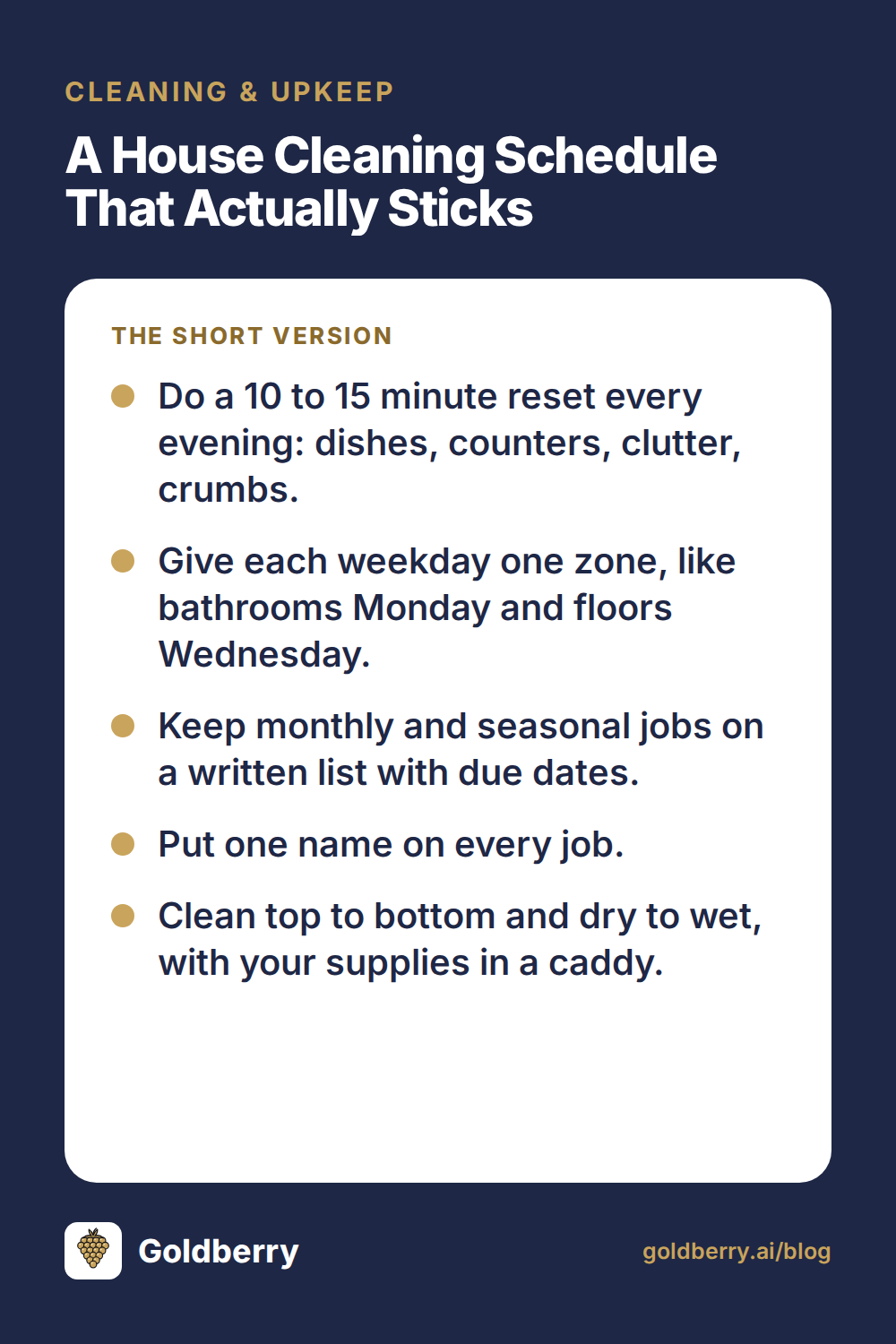
A House Cleaning Schedule That Actually Sticks
A cleaning schedule built on 15-minute daily resets and one zone per weekday, so the house stays clean and you stop losing your Saturday to chores.
A cleaning schedule that sticks has three layers: a 10 to 15 minute reset every day, one zone per weekday, and a written list for monthly jobs. The daily reset keeps the mess small, so each weekly job takes 20 to 30 minutes instead of eating your whole Saturday.
Schedules usually fail because they ask for too much at once. This one keeps each day's work small and puts every job in writing with a name next to it.
Start with a daily reset
The daily reset is the base of the whole schedule. You are only putting things back where they belong so tomorrow starts clean. Deep cleaning comes later in the week.
Pick a fixed time. Right after dinner works for most households, because the kitchen is already the messiest room. Set a timer for 15 minutes and stop when it rings.
| Daily job | Time | Notes |
|---|---|---|
| Load or run the dishwasher | 5 minutes | Hand wash only what won't go in |
| Wipe counters and stovetop | 3 minutes | Spray, wipe, done |
| Clear the table and one drop zone | 3 minutes | Mail, bags, shoes |
| Sweep or vacuum the kitchen | 2 to 3 minutes | Only where crumbs show |
| Put away stray items | 2 minutes | Carry a basket from room to room |
If the kitchen is your biggest daily drain, a kitchen reset routine can bring it down to a few minutes on its own.
Two tiny habits help even more, and each takes under a minute.
Wipe the bathroom sink after you brush your teeth at night. Start a load of laundry in the morning if the hamper is full.
Spread weekly jobs one zone per day
The classic plan is to clean the whole house on Saturday. It takes three or four hours, it wrecks your weekend, and if Saturday falls apart, nothing gets cleaned that week.
Give each weekday one zone instead. Each job takes 20 to 30 minutes because the daily reset stops the mess from building. If you miss a day, only one zone slips, and it can wait a week.
| Day | Zone | Main jobs | Time |
|---|---|---|---|
| Monday | Bathrooms | Toilets, sinks, mirrors, shower or tub, floor | 20 to 30 minutes |
| Tuesday | Dusting | Shelves, surfaces, TV stand, switches, door handles | 15 to 20 minutes |
| Wednesday | Floors | Vacuum all rooms, mop hard floors | About 30 minutes |
| Thursday | Kitchen | Microwave, toss old leftovers, appliance fronts, sink scrub | 20 to 30 minutes |
| Friday | Bedrooms and linens | Wash towels, clear surfaces; every week or two, strip all the beds and wash the sheets as their own load | About 20 minutes |
| Saturday | Catch-up | Whatever slipped this week | 0 to 30 minutes |
| Sunday | Off | Glance at the week ahead | 0 minutes |
Move the days around to fit your life. If Wednesday is packed with practices, put floors on Tuesday. What matters is the same job on the same day every week, so you stop deciding and just do it.
Shorten the plan for a small home
In a small apartment, fold dusting into Thursday and floors into Monday. That leaves three short sessions a week instead of five. Keep the daily reset either way.
Put monthly and seasonal jobs on a list
Monthly jobs cause the most stress because they live in your head. You remember the oven when it smokes. You remember the baseboards when guests are on their way.
Write them down with a rough week of the month for each. Then add one monthly job to your catch-up Saturday or to a weekday that runs short.
| Monthly job | Time | Suggested week |
|---|---|---|
| Wipe baseboards and door frames | About 30 minutes | Week 1 |
| Wipe fridge shelves and drawers | About 20 minutes | Week 1 |
| Wash the shower liner and bath mats | 10 minutes of hands-on time | Week 2 |
| Wipe out the oven | 20 to 45 minutes | Week 2 |
| Vacuum under cushions and furniture | About 20 minutes | Week 3 |
| Clean the dishwasher filter | About 5 minutes | Week 3 |
| Dust light fixtures and fan blades | About 20 minutes | Week 4 |
| Clean windows and door tracks | About 30 minutes | Week 4 |
Seasonal jobs go on the same list with a month next to them: outside windows, the garage, rotating the mattress if the maker recommends it. Jobs that protect the house itself, like filters, gutters and alarms, belong on a separate home maintenance checklist.
Give every recurring job a repeating reminder with a due date. Then you check the list instead of trying to remember it.
Give every job an owner
"Someone should clean the bathroom" means nobody will. Every job on your schedule needs one name next to it.
- List every daily and weekly job.
- Let each person pick one job they don't mind.
- Split the rest by time, not by count. Bathrooms take longer than dusting, so they count for more.
- Rotate the jobs nobody wants every week.
- Post the names where everyone can see them.
Kids can own more than you might expect. A five-year-old can match socks and wipe a low table, and a ten-year-old can clean a bathroom sink.
See chores for kids by age for a realistic list.
Let the owner decide how the job gets done, within reason. If you redo their work, they will stop doing it.
Clean top to bottom, dry to wet
Order matters. Dust falls, and wet cleaning turns dust into streaks and mud. A set order means you clean each surface once.
- Pick up clutter so surfaces are clear.
- Spray wet cleaners on sinks, counters, tubs and toilets, and let them sit while you dust (check the label for how long).
- Dust high things: fan blades, shelves, tops of frames.
- Dust lower surfaces next: tables, sills, baseboards.
- Wipe the sprayed surfaces, then the mirrors.
- Vacuum the floor.
- Mop last, working toward the door.
In a bathroom, spray the toilet and tub first. Dust while the cleaner works, then scrub and finish with the mirror. You never stand around waiting.
Never mix cleaning products. Bleach mixed with ammonia or with acids like vinegar gives off toxic gas. Use one product, rinse, and only then use another.
Carry a caddy
Walking back to the kitchen for a cloth three times can add several minutes to a job. A caddy fixes that. Keep these in one tote with a handle:
- An all-purpose cleaner
- A glass cleaner
- A toilet cleaner (keep a brush in each bathroom)
- Five or six microfiber cloths
- A scrub brush and a sponge
- Small trash bags
- Rubber gloves
In a two-story home, keep a second basic kit upstairs. Doubling up costs a little and saves trips every week. If you have young kids, store the caddy up high or behind a latch.
Make it stick for the long run
Start with only the daily reset for two weeks. Once it feels automatic, add the weekly zones. Add the monthly list last.
Lower the bar where you can. A bathroom wiped for 10 minutes every week stays cleaner than one scrubbed for an hour once a month. Good enough on schedule beats perfect now and then.
When life gets busy, drop back to the daily reset alone. The house won't sparkle, but it won't fall apart either, and you can pick the zones back up next week.
FAQ
How long should a weekly cleaning schedule take?
With a daily reset of 10 to 15 minutes, most homes need 20 to 30 minutes per weekday zone, or roughly two to three hours across the week. That is less than one big Saturday clean, in pieces small enough to fit around work and school.
What should be on a house cleaning checklist?
Daily: dishes, counters, clutter and crumbs. Weekly: bathrooms, dusting, floors, the kitchen and tossing old leftovers, with sheets every week or two. Monthly and seasonal: baseboards, fridge shelves, the oven, fan blades, windows, the dishwasher filter and bigger jobs like the garage.
What is the best day to clean the bathroom?
Pick a day early in the week, like Monday, so a busy weekend can't push it back. The exact day matters less than keeping it the same every week. A quick sink wipe each night keeps the weekly clean to about 20 minutes, even in a bathroom the whole family shares.
How do I keep a cleaning routine going when I'm tired?
Tie the reset to something you already do, like finishing dinner, and stop when a 15 minute timer rings. On rough days, do only the dishes and counters. A short routine you keep beats a long one you skip.