A Simple Laundry System for Busy Families
A family laundry system that keeps clothes moving, with one hamper per person, a set wash schedule, and one session from washer to drawer so nothing piles up.
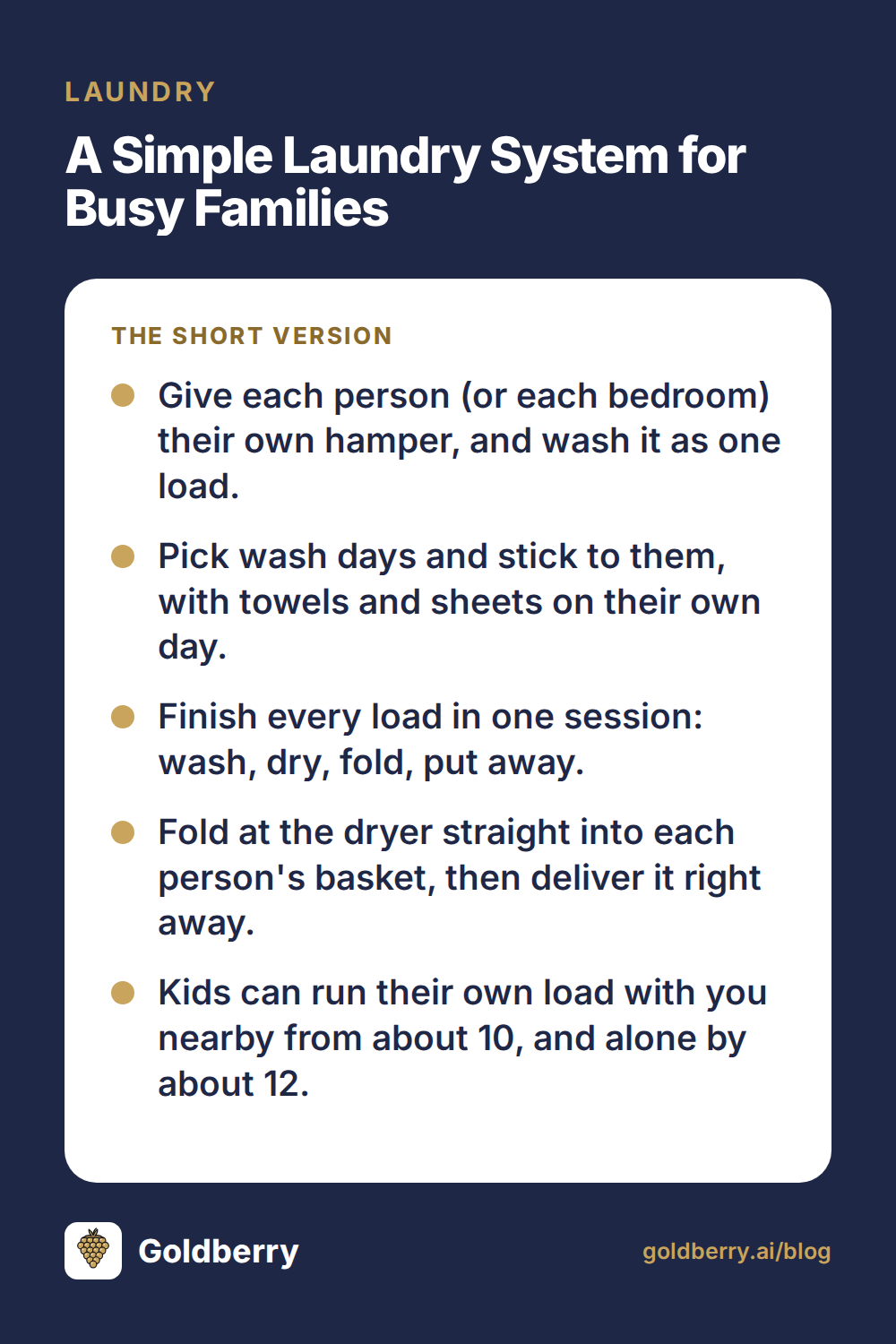
The simplest laundry system for a busy family is one hamper per person, a set wash schedule, and finishing every load in one go: wash, dry, fold and put away the same day. Do that and laundry stops being a mountain and becomes a short, steady job you barely notice.
The trouble usually lives in the in-between steps. Clothes wait to be sorted, clean clothes live in baskets, and someone digs for socks at 7 a.m. The setup below gets rid of those waiting spots.
One hamper per person ends sorting
Put a hamper in each bedroom, or one per person if you want things even simpler. When it's laundry time, that hamper is the load. Nothing gets mixed, so nothing needs sorting by owner on the way out.
This one change saves the most time. You skip the sorting pile on the floor before washing and the sorting pile on the bed after drying.
For most everyday clothes, you don't need to split lights and darks either. Cold water and modern detergent handle a mixed load well, with a few real exceptions. The details are in do you really need to sort laundry.
Sizing the hamper
Pick a hamper that holds about one washer load. When it's full, it's time. Kids learn that rule fast, and you can see at a glance whose turn is coming up.
Set a wash schedule
A schedule means you stop deciding. Laundry happens on its days, and nobody has to notice that the hampers are overflowing.
Here's a sample week for a family of four or five:
| Day | Load |
|---|---|
| Monday | Parents' hamper |
| Tuesday | Kid 1 |
| Wednesday | Kid 2 |
| Thursday | Kid 3, or a second parent load |
| Friday | Free day (catch-up or nothing) |
| Saturday | Towels and kitchen cloths |
| Sunday | Sheets, every week or two |
A smaller household might do everything in two sessions a week instead. Both work. If you're not sure which fits you, compare the two approaches in laundry day vs a load a day.
Towels and sheets get their own day
Towels and bedding are bulky, take longer to dry, and shed lint onto clothes. Keeping them on a separate day makes clothing loads faster and lets you wash towels warmer if the care label allows. For sheets, strip every bed on the same day and wash them as their own load, every week or two.
Finish the whole load in one session
Count a load as finished when the last sock is in a drawer, not when the dryer buzzes. Clothes that wait in a basket get crumpled by people hunting for one shirt, and some get washed again without ever being worn.
Plan each load as one session:
- Start the washer so it finishes while you're home. A delay-start setting helps.
- Move it to the dryer right away, and make sure someone will still be home when the dryer stops.
- Fold and hang at the dryer the moment it stops, while clothes are warm and smooth. That means fewer wrinkles and less ironing.
- Put everything away right then.
The hands-on time is about 15 to 20 minutes per load. The machines do the rest while you do something else.
Fold at the dryer, straight into each basket
Keep one small basket per person next to the dryer, plus a rod or hook with empty hangers. As you pull clothes out, hang shirts and dresses right away and fold the rest straight into the right basket.
Then carry each basket to its room and put things away, or hand it to its owner. The basket comes back empty to the laundry area. It never becomes storage.
You can cut folding time a lot by folding less. Underwear, socks, pajamas and most kids' clothes can go into bins or drawers unfolded. See what not to fold for the full list.
Let kids own their laundry
From about age 10, most kids can run their own load with you supervising, and by about 12 they can do it start to finish on their own. Since each child has their own hamper, their laundry is a complete job with a clear start and end.
Teach it in steps over a few weeks:
- Do it together, with them watching and helping.
- They do it while you watch and coach.
- They do it alone, and you check that it got put away.
Younger kids can still help. A 4-year-old can carry a small basket and put clothes in the right drawer, and a 6- or 7-year-old can move clothes to the dryer and fold towels. For more ideas, see chores for kids by age.
Tape a card by the washer with the steps: how much detergent, which wash setting, which dryer setting. Then nobody has to ask which button to press.
Cut down the volume
Less laundry is the easiest laundry. A few habits shrink the pile without anyone feeling short on clothes.
Socks that don't need pairing
Matching socks is a small job that eats more time than it should. If each person's drawer holds only one kind of sock, any two go together and a lost one costs nothing.
Fewer clothes overall
When everyone has fewer clothes, hampers fill at a steady pace and drawers actually close. A rough guide is enough outfits to cover the days between that person's wash days, plus a few spares. You'll also spend less on clothes that never get worn.
Rewear what isn't dirty
Jeans, sweaters, pajamas and outer layers can usually be worn more than once. Teach everyone to hang up or fold back what's still clean instead of tossing it in the hamper. Towels can be used several times if they hang to dry between uses.
Keep the system running
A system only works if it survives a busy week. A few small habits help it hold up:
- Keep detergent, stain remover and hangers within arm's reach of the machines.
- Treat stains when they happen, or at least before the item goes in the hamper.
- Clean the dryer lint screen after every load. Clothes dry faster and it lowers fire risk.
- Empty pockets at the hamper, not at the washer. Each person checks their own.
- If you miss a day, do that hamper on the free day. Don't try to double up later.
Most families find a new routine settles in after two or three weeks. After that, laundry stops being something you think about.
FAQ
How often should a family do laundry?
Most families of four or more do best with a load most days, or three to four wash sessions a week. Smaller households can usually get by with one or two. The right frequency is whatever keeps hampers from overflowing and clean clothes out of baskets, so pick a schedule and adjust after a couple of weeks.
How do I keep up with laundry when I work full time?
Use the delay-start on your washer so a load finishes when you get home, then run the dryer and fold the moment it stops. Give each person's hamper a set day, move towels and sheets to the weekend, and have older kids run their own loads. Short, regular sessions are easier to keep up with than one huge weekend pile.
At what age can kids do their own laundry?
Many kids can run a load with an adult supervising from about age 10, and handle it start to finish alone by about 12. Younger kids can help earlier by carrying baskets, moving clothes to the dryer, folding towels and putting their own clothes away from about 4 or 5. Keep written steps by the washer so they don't have to remember the settings.
Should I wash each person's laundry separately?
Washing one hamper per person as one load saves the most time, because nothing needs sorting before or after. It works best when each hamper holds about one full load. If someone's hamper fills slowly, like a baby's, wash it every few days with another small hamper and fold into two separate baskets.